Peer Review Proccess
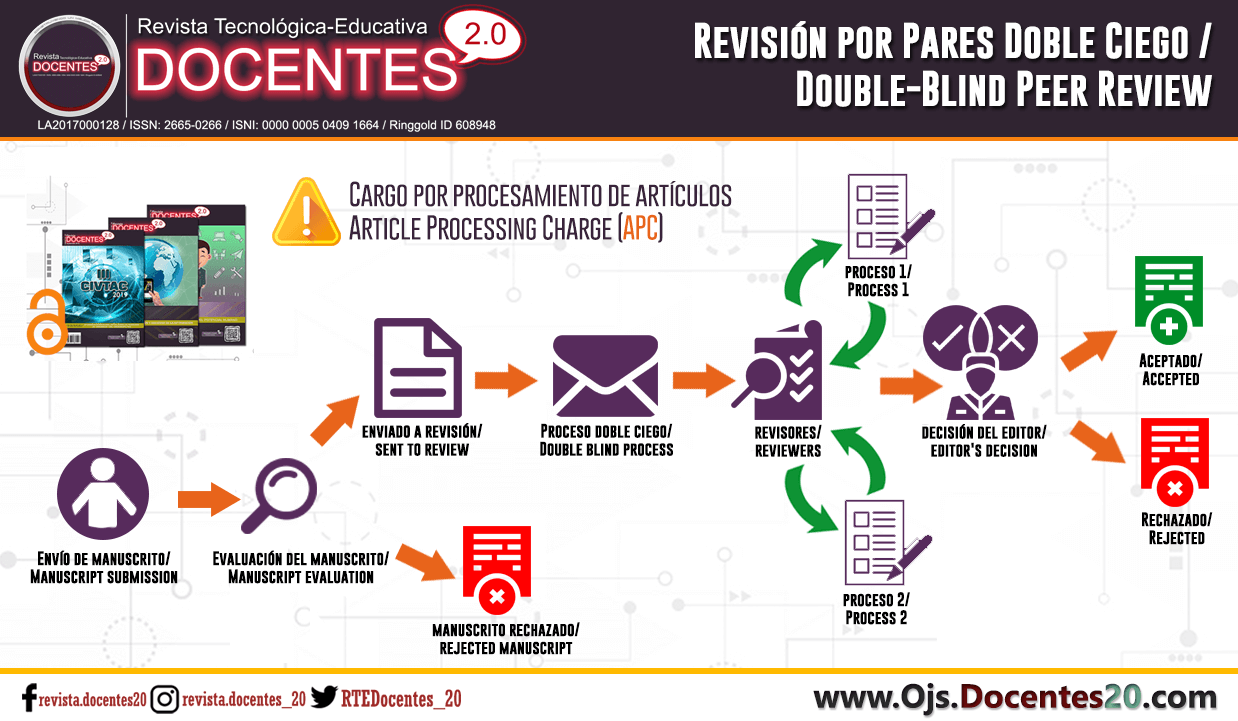
PEER REVIEW PROCESS
– Docentes 2.0 Journal implements a double-blind peer review system, in which the identities of both authors and reviewers are kept confidential during all stages of the editorial process and are not revealed after publication. There is no direct communication between authors and reviewers.
– To guarantee the double-blind process, authors must submit anonymized files (without names, affiliations, acknowledgments, or other identifying information), and the editorial team performs an additional review to remove identifiable metadata before assigning reviewers.
– Reviewers receive no financial compensation for their work and must act with academic independence, impartiality, and confidentiality, in accordance with the Principles of Transparency and Best Practice in Scholarly Publishing and the Committee on Publication Ethics (COPE) guidelines. Scientific evaluation and editorial decisions are made independently of any financial consideration.
1. Preliminary Evaluation and Originality Verification
Before initiating peer review, all manuscripts undergo:
- Verification of formal compliance and adherence to editorial guidelines.
- Evaluation of thematic relevance within the journal's scope.
- Originality check using specialized similarity detection software.
If plagiarism, substantial self-plagiarism, citation manipulation, or improper use of sources without adequate citation is detected, the manuscript will be immediately rejected according to the journal's academic integrity policy.
When applicable, authors must declare the use of automated tools and/or generative artificial intelligence (AI) in the preparation of the manuscript, beyond style and format editing, in accordance with current editorial policies.
2. Stages of the Editorial Process
Initial Review (1–2 weeks)
The Editor-in-Chief verifies formal requirements, thematic relevance, and originality. Manuscripts that do not meet these criteria are rejected without external review.
Reviewer Assignment (approx. 1 week)
The manuscript is sent to a minimum of two external expert reviewers, selected based on:
- Verified academic experience
- Recent publications in the area
- Institutional affiliation
- Absence of conflicts of interest
The journal implements measures to prevent peer review manipulation (including fake reviews): identities and affiliations are verified, and reviewer suggestions using generic emails without validation are not accepted. If necessary, the editorial team appoints independent reviewers.
In cases of significant discrepancy between evaluations, a third independent external reviewer will be appointed.
Peer Review (3–4 weeks per round)
Reviewers submit independent and anonymous reports, which may recommend:
- Accept submission
- Accept with minor revisions
- Major revision
- Decline submission
Editorial Decision (1–2 weeks after reports)
The Editor-in-Chief makes the final decision based exclusively on the reviewers' reports. The technical content of the reports is not modified.
When the President or the Editor-in-Chief appear as authors or co-authors, editorial management and final decision authority are assumed by the External Co-editor. In such cases, the editorial file is reassigned in Open Journal Systems (OJS) to the External Co-editor, who oversees the review process and issues the final decision. The Editor-in-Chief and any member with a conflict of interest do not access the reviewers' reports nor participate in the evaluation or decision-making process.
Author Revisions (2–4 weeks per round)
Authors must submit a revised version of the manuscript along with a detailed response letter addressing each comment. Unjustified failure to meet deadlines may result in the administrative closure of the manuscript.
Editorial Production and Publication
Once accepted, the manuscript moves to copyediting, bibliographic standardization, layout (PDF, HTML, ePub, and XML-JATS), and DOI assignment. The journal publishes two issues a year, in May and November. Accepted articles are scheduled according to the editorial calendar.
3. Estimated Timelines
- Average time from submission to final editorial decision: 16 to 20 weeks.
- The average time to first decision is included within this range.
- The complete editorial process, including review rounds and production, will not exceed a maximum of twelve (12) months, except in duly justified exceptional circumstances.
4. Evaluation Criteria
- Originality and contribution to knowledge.
- Relevance to the journal's scope (Education, Technology, and Social Sciences applied strictly to techno-pedagogical innovation).
- Methodological rigor and scientific soundness.
- Argumentative coherence and clarity.
- Timeliness and relevance of references.
- Compliance with editorial guidelines.
- Compliance with ethical research principles (when applicable).
5. Confidentiality, Conflicts of Interest, and Ethics
Reviewers must declare potential conflicts of interest before accepting the review invitation and must decline participation if such conflicts exist. If a conflict is identified later, the journal may reassign the manuscript to new independent reviewers. Reviewers must act under strict confidentiality. In particular:
- They may not share the manuscript with third parties.
- They may not use external artificial intelligence tools without editorial authorization.
- They may not use the information contained in the manuscript for personal or third-party benefit.
- They must destroy or delete copies of the manuscript once the review is complete.
Members of the Editorial Committee, including the Editor-in-Chief, do not manage or evaluate manuscripts of their own authorship, from their institution, or from projects in which they have direct participation.
6. Communication with Authors
All official notifications and communications are made exclusively through the Open Journal Systems (OJS) platform. Authors receive notifications at each stage of the editorial process (initial review, external evaluation, revision requests, final decision, and publication scheduling).
7. Appeals Policy
Authors may submit a formal appeal within 15 days following the notification of the editorial decision. Appeals must be duly justified and will be evaluated by the Editorial Committee. If deemed appropriate, the manuscript may be re-evaluated by new independent reviewers.
8. Transparency and Traceability
Docentes 2.0 Journal fully documents each stage of the editorial process within Open Journal Systems (OJS), including submission dates, reviewer assignment, issued reports, and final editorial decisions. For accepted manuscripts, the journal issues a Certificate of Acceptance specifying the type of peer review applied (double-blind with at least two independent external reviewers). The reviewer database is periodically updated to ensure institutional and geographic diversity. Editorial records are maintained in accordance with the journal's confidentiality and academic traceability policies.
9. Editorial Statistics
The journal annually publishes editorial statistics, including acceptance and rejection rates, average review time, and the number of processed manuscripts.
10. Policy on Editorial Team Submissions
All contributions, including those submitted by members of the editorial or administrative team, are evaluated through the same double-blind peer review process. The journal maintains a strict separation between administrative management and scientific decision-making, guaranteeing editorial independence, impartiality, and transparency at each stage of the process.